
Searching for a specific email in Outlook can prove challenging. Outlook search can sometimes return irrelevant results while missing the exact email you need. Microsoft is looking to improve that frustrating experience with a revamped search.
The new search has a feature that genuinely removes the most frustrating part of Outlook for me. That phrase is thrown around a lot online and is often clickbait, but I mean it here emphatically.
Outlook now handles stop words better. Those words, such as “the,” “and,” and “is,” often clog search results with irrelevant emails. I can’t tell you how many times those tiny words have led to terrible searches that made me fish through the results that appear chronologically.
Microsoft’s example from a blog post shows how drastically different the results are when searching “the FY27 budget” using the old Outlook search versus the new one.
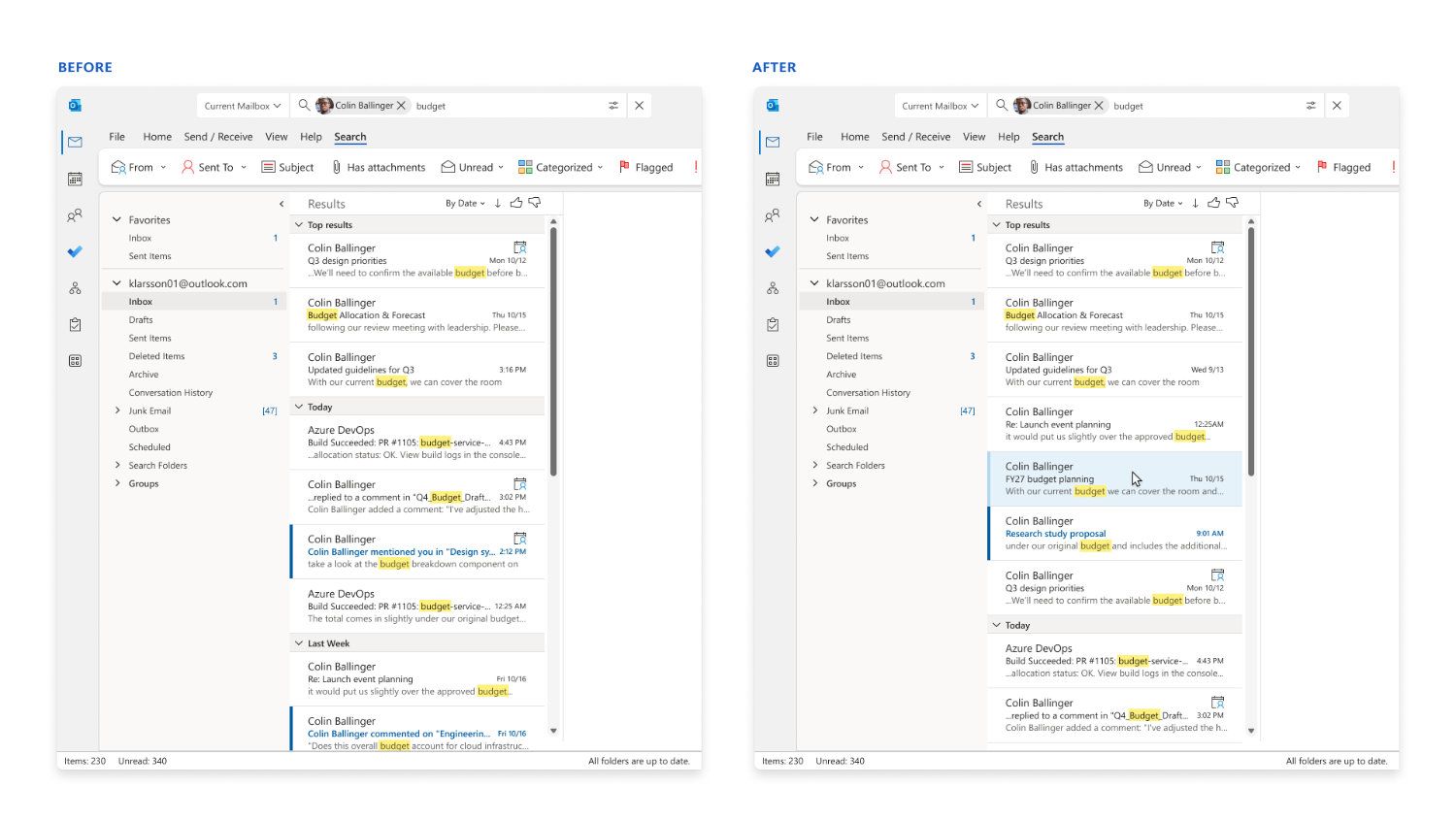
The improvements highlighted by Microsoft center around ranking emails better. Microsoft focused on three areas when building the new search tool in Outlook: better ranking, improved performance when connectivity is poor, and a tighter feedback loop.
When you search for an email within Outlook, you will see seven ranked results rather than three. Those emails are ranked based on recency, sender, how much the message has been interacted with, and other factors. Expanding the number of ranked messages presented should show users more relevant emails while also helping Microsoft improve its ranking systems over time.
The new ranking layout is available across several versions of Outlook, including the new and Classic versions.
There are other upgrades as well. Classic Outlook now automatically falls back to locally indexed content when connectivity is poor. That same functionality is on the way to new Outlook but will ship later.
Users of Classic Outlook should also see faster search results. Microsoft also said recent improvements reduced latency for the slowest 5% of Outlook searches.
The improved rankings in Outlook are the result of a small language model ranker built specifically for Outlook. That model is trained through distillation, meaning it is built under the supervision of a larger model.
Distillation helps Outlook search be more efficient than if it had to run a larger model just to look through and rank emails.
I’d probably be okay with using a larger model in Outlook if it cut out irrelevant results that appear simply for using an article or common verb like “is.” I bet I’d still save some time that way. But I don’t have to test that theory because the new Outlook search is lightweight.

Join us on Reddit at r/WindowsCentral to share your insights and discuss our latest news, reviews, and more.